Monday, May 2, 2011
Live A Little, Love A Little (1968, Norman Taurog)
But it very nearly gets it right. What begins as a ridiculous male fantasy with a beautiful (perhaps mentally unstable) woman relentlessly throwing herself at our hero ends with a clear domestication of the male spirit. It's playfully subversive romance that resolves like the gender roles in (another photography movie) Rear Window. "I'm a man, I like to make decisions for myself. If you ever start thinking like a woman, you'll understand what that means," Elvis's Greg Nolan tells "Bernice" (the stunning Michele Carey) in an argument. But it's clear who's on the leash when, upon reconciliation at the beach, Bernice tells Greg "I'll meet you half way," only they embrace without her taking a single step.
Bernice spots Greg on the beach one morning though her telescope and sends her Great Dane, Albert down to exert a little muscle. It's one of the few altercations Elvis doesn't win: Albert chases him into the ocean and Greg is played for a fool. Bernice (or is it Alice? Or Betty? Suzie?) has different names for different moods and each man in her life knows her by a different one. She's clearly meant to embody the late '60s free spirit who uses sex to hide the fear of connecting with someone in love. Kinda like Julie Christie in Petulia (or David Warner in Morgan!): the anarchic world is treated by youth with lunacy. Bernice is the sexual aggressor, and that, too, is something an Elvis character is unfamiliar with. She dangles the carrot in front of many faces, but she is played more a headcase than a tramp. And it is such behavior that provokes Greg's jealousy, flipping the script, painting the typical Elvis role as hypocritical.
Bernice quickly loses Greg's apartment and job, finds him a new apartment and pays his back rent, making him deeply indebted to her. In an act of counter-aggression (preserving his male dominance), he gets not one, but two simultaneous jobs as photographer (one a very professional, conservative publisher, another for a more casual girlie magazine). Shenanigans ensue as Greg juggles two jobs and Bernice juggles men, always subverting said dominance.
It's a real shame that throughout the many Elvis musicals, there was never anything cinematic about the numbers. The closest he ever came was probably "Jailhouse Rock", but even that looks like it was a filmed version of something produced for a stage. Too often, the choreography would have action surrounding Elvis, but he would just be standing, awkwardly snapping (or worse, rhythmically clapping) and staring into the camera. Live A Little, Love A Little isn't a conventional musical, but they procure a decent number in a dream sequence that involves a man talking to Greg from inside a dog suit, Greg falling into a psychedelic rabbit hole and then performing "Edge of Reality" on a desolate sound stage. Really? A very visual photographer has a psychedelic dream and the location is pastel disco-lit non-location white room?
The other numbers (of which there are very few) are less performance than narrative. They include the once obscure "A Little Less Conversation", whose remixed version would become a number one hit in the UK 25 years after Presley's death.
Live A Little, Love A Little is full of beautiful women and, while they try to throw in a side romance with Celeste Yarnall, the chemistry between Presley and Carey is spot on. It may be the only true Presley romance, as the formula of his prior seventeen films had the romance as a side dish: a free dessert that cost nothing of the characters and was, therefore, of little value. That isn't to blow this light screwball comedy out of proportion, but the film is stronger because there are stakes involved.
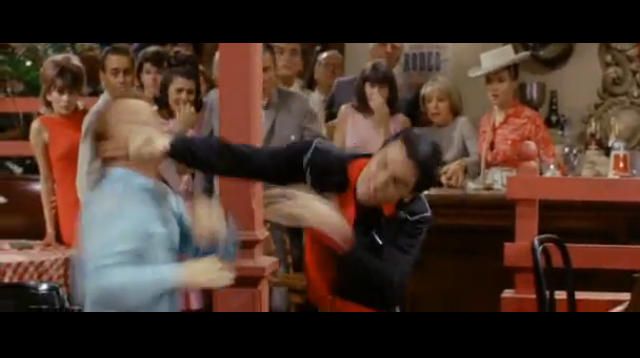
This would be Taurog's last film before he was overcome with blindness, but his eye for comedy and beautiful women is in full force here. Dumb touches like Elvis speeding around the beach in a dune buggy and Albert the Great Dane making faces and covering his eyes are shot without a shred of irony and fit the tone of the picture. Elvis even decks Darrin #2 from "Bewitched". Consider it Presley's first film as an "adult"-- formula would take a backseat in the few remaining films of Presley's career, and each are better for it. Live A Little, Love A Little is a fine swansong to the testament of Taurog's work. -- **½ / four stars
Back to The Films of Elvis Presley
Sunday, May 1, 2011
Speedway (1968, Norman Taurog)
Elvis's own entourage, The Memphis Mafia, a group of twentysome good ol' boys, many of whom Elvis's childhood friends he "rescued" from poverty, followed Presley everywhere he went on his dime. Historian Patrick Humphries summed up the Mafia as "Elvis' bodyguards, babysitters, drug procurers, girl-getters, mates and carbuyers." I wonder how much of Presley's earnings were seen by him in his heyday: not only was the Colonel reaping upward to 50%, many of the Memphis Mafia were getting upwards to $500 a week. They partied with Elvis every day and every night, trafficking the drugs Presley requested and taking pills just to keep up with one another. And they nearly despised Priscilla who made (most of) them move out of Graceland after the wedding in 1967.
Lechers, probably, but that isn't to say the Mafia was all bad: in some ways the Memphis Mafia may have prevented the actual mafia from stepping in and trying to overtake Presley's career in a way that dogged Frank Sinatra's career. Realistically, it probably wasn't too dissimilar from an actual job for many of them, waiting on the King's every whim, day or night. To live near Elvis was to have a seat aboard the gravy train: his concept of wealth was the ability to lavish gifts onto others. He gave to charities and he gave frivolously. It is only natural that people took advantage of this generosity, much like Jamie takes lecherous advantage of Lamar Odom.
Speedway is a strange narrative of a problem only relevant to such a minority of celebrity. Elvis plays stock car racer Steve Grayson with all the same problems as Elvis: he has more money than he knows what to do with, so he spends it on the most frivolous gimmicks imaginable with the intent to lure women. His lecherous "manager" Kenny (Bill Bixby) is his childhood friend who Steve shares his women and bankbook with. Kenny's love of luxury and gambling get Steve unknowingly in trouble with IRS, and agent Susan Jacks (Nancy Sinatra) swoops in to investigate.
In film is more overtly sexist than most Elvis pictures, and for much of the film Steve and Kenny live out a bros-before-hoes philosophy, pulling the obnoxious Gene Wilder trick of self-referentially stating your intentions clearly through the fourth wall though the women are too dense to pickup "I have a little trick of my own, [it'll only take a minute]" is a double entendre. Steve is the kinda guy that can owe the IRS insurmountable sums, strong-arm (and sweet-talk?!) a female IRS agent, and still have everything work out for him. But like any Elvis picture, it's more morally ambiguous than that. Steve (like Elvis) is also extremely charitable, dishing out money to help an out of work racing buddy who somehow is the father to five motherless girls all between the age of three and six.
What begins as buying a hot dog dinner turns into a real-life Elvis situation of buying automobiles to help the family. Steve encounters Ellie (Victoria Paige Meyerink), a precocious young girl (the only way they show up in any Elvis movie), and even sings her a slightly creepy song about how it would probably be inappropriate for the two of them to get married, but reassures her that she will be a beautiful woman. For the record, that didn't exactly pan out.
Nancy Sinatra appears courtesy of two number one singles ("These Boots Are Made For Walkin'" and "Somethin' Stupid") and a dropout by Petula Clark. Her performance is passable, but the chemistry uninspired but, to be fair, you could probably say that about many of Presley's performances. She does get to perform a snaky "Your Groovy Self", much in the same vein as "Boots". Sinatra has a great mod look that isn't really used in the film, and her lip-syncing skills weren't exactly up to par.
A performance I was much more into was a straight-faced daffy, choreographed number by Presley and businessmen in an IRS office called "He's Your Uncle, Not Your Dad". Taurog's earnest style treats the material like it's Vincente Minnelli. You'd never use the word "sublime" to describe the musical numbers in an Elvis comedy, but it's not for any lack of effort on Taurog's behalf. It's ridiculous, campy and a joy.
It's notable that Speedway doesn't really pan out for its hero in the end. Unlike Viva Las Vegas, after having to also build an engine overnight, Steve fails to win the big race. The movie ends with him still being on the hook for $137,000, still enabling (or is it, being enabled by) Kenny, and everyone is blissfully ignorant because Elvis and Nancy kiss. It isn't troublesome that Steve wrecked his car twice in 24 hours, there is no fear of Steve falling into the same trouble as the disabled Abel Esterlake. The moral is youth known no bounds, and the consequences are as light. But say what you will, it can't be called hypocritical. Elvis lived his life the same way and managed to get out of his soured movie career. Speedway would be his last significant box-office success and his last traditional, teen-oriented musical-comedy. He would finally be able to take on more "adult" roles, which is pretty funny considering the lifestyle perpetuated by Speedway, a Peter Pan syndrome enabled by uncountable sums of money, was how he would continue living until his death in 1977. -- *½ / four stars
Back to The Films of Elvis Presley
Thursday, April 28, 2011
Double Trouble (1967, Norman Taurog)
I can't overstate the "Old MacDonald" scene: it's where everything seemed to come to a head in Presley's discontent. The music isn't as bad as his prior film, Easy Come, Easy Go, but the songs aren't memorable in a good way. His choreography amounts to little more than his awkward, somewhat-rhythmic snapping and sometimes he pretends to play instruments. Double Trouble would have been one instance in which no music would have been a good move.
But music notwithstanding, two distinct differences in Double Trouble really work for it. First of all, like Tickle Me, the movie is outright zany in a Don Knotts sort of way. The plot doesn't try to walk a line between celebrity aura and a teen fantasy world where one could just maybe stumble upon Elvis. Double Trouble takes place in Europe (though shot exclusively in a Hollywood studio), has characters disguising their identities and physical violence is used for slapstick.
This isn't done altogether perfectly: timing, after all, is everything in comedy, and a lot of the beats miss. One sequence feels lifted directly from Billy Wilder's Some Like It Hot, not only in tone, but in a quip of dialogue delivered by Presley. The film fails to march out the rhythm it tries to set, but its heart is in the right place.
Furthermore, while the danger is cartoonified, the film carries bona fide consequence. The film is delightfully screwball (well, at least cornball), but characters are firing guns. The mysterious, malevolent hand is trying to knock off our heroes. It is played for laughs, but characters do die. It's a welcome escape from the Elvis Movie World of even-tempered, wind-blown sand resolve.
It doesn't change the fact that the plot is more than a little creepy: Presley's Guy Lambert is an (American?) singer touring Europe and willing to take home a woman any night of the week. When he happens to take home young red-head Jill Conway (Annette Day), he has no idea that she is due to receive a large inheritance. Nor does he realize that she is only seventeen. The schoolgirl plays hard to get until Guy finds out the whole story. Then she turns into a Lolita, trying to wed him, stat.
The lines drawn by Guy's conscience are indecipherable. The threat of statutory was a cold shower initially, but then they're off kissing again. The movie takes place over the final three days before Jill's eighteenth birthday, but it's just a little uneasy. And at this point in the Elvis formula, I welcome the lack of conformity (not to mention, he courted Priscilla when she was a mere fourteen).
Elvis and redheads were a winning formula throughout the franchise-- Ann-Margret and Deborah Walley were enough to make their respective films pull away from the pack, and their chemistry with the King really worked. Double Trouble "co-stars" and "introduces" the world to Annette Day, an all too British-looking female lead who, after said introduction, would never be featured in a film again. Not only does the film call for a strange chemistry, Day just doesn't have the pull on-screen to make it work.
Double Trouble isn't exactly a spoof, but it riffs on mod culture (a welcome atonement from the out-of-touch treatment of Beatniks in Easy Come, Easy Go), and isn't too out of line with something like Murder By Death. There are many ways in which the film doesn't work, but its chutzpah makes up the difference. -- **/four stars
Back to The Films of Elvis Presley
Tuesday, April 26, 2011
Spinout (1966, Norman Taurog)
To put things into perspective a bit, 1966 saw a few important things in the history of rock and roll. Those things included Pet Sounds and Revolver. While some might attribute the success and popularity of those two pieces to innovative song craft and the propulsion of the "album" as a unified piece of art, some marketers in the Presley camp thought perhaps it was due to a bunch of goofy guys being in a band instead of just one singer. I mean, I like "God Only Knows" as much as the next guy too, but it's hard to beat the "you stepped on my french fries!" hamburger camaraderie of five guys goofing around with the tape rolling in the Beach Boys' "Bull Session with 'Big Daddy'", right? Right?
So, like Girl Happy, Elvis's Mike McCoy is a frontman to a band of forgettable minors as opposed to a one-man show. But that's not all, Viva Las Vegas was a success too, so Elvis can also race cars in this one. And, heck, the more girls the better, so we'll have three girls vying for Elvis's hand in marriage instead of the usual two.
Only, I'm not convinced that this riffing of the typical Elvis formula isn't somewhat tongue-in-cheek. And a few of the characters on the sideline really sell it, not the least of which is played by the spunky Deborah Walley (no stranger to bikini, Hawaiian or racecar pictures herself). Walley's character, Les, is the jealous girl-next-door drummer in Mike's band. Obvious to everyone but Mike, Les nearly outbursts when Mike's attention is drawn to wealthy sophisticate Cynthia (Shelley Fabares) or when he starts becoming the subject of bookworm Diana St. Clair's (Diane McBain) next piece, The Perfect American Male.
The introductions of Cynthia and Diana are ludicrous as to do the screwball genre proud: one has her father offer the band $5000 to play her birthday party, the other hunts Mike down in the woods to study him for her book. Mike has no problem kissing and telling, but unlike any Elvis we've seen before, he plays remarkably hard to get. Elvis refuses to be tied down so, in opposition Blue Hawaii and Viva Las Vegas, Spinout doesn't end in a wedding. It ends in three.
Elvis walks away from the altar, marrying off all his suitors to better fits (more perfect American males?). As such, there is are nearly too many characters in this movie but they are adequately acted and the lack of one-man-show structure is a benefit to the narrative. While it's obviously no Palm Beach Story, it's a pleasant and unoffensive tryst along the same lines. It's an Elvis movie that bucks trend, and is owed some credit for it. Believe it or not, Elvis doesn't even get in a brawl in this one.
Like any movie where Elvis drives a convertible, there is a large amount of green-screen. However, Taurog's treatment of it for dialogue rather than travelogue makes it forgivable and relatively unnoticeable. Furthermore, the choreography of some one-off light gags (like the band setting up camp) is a testament to Taurog's circumspection if not outright sophistication. It is also proof that, in the hands of a veteran filmmaker (as opposed to television director), an Elvis movie can have a tight budget and studio lighting without looking cheap. The songs aren't particularly memorable, but they also don't stand out like a sore thumb when they come out of nowhere. Here, they never take away from the narrative and, for a change, we're anxious to get back to it.
Spinout doesn't go out of its way to make Elvis a deity or even a particularly likable character (one particularly uncouth song has Elvis singing that he loves his women like a "Smorgasbord"). The film is shaken up with so much commotion, Elvis is allowed to portray the main character without having to constantly be the central focus. While not every attempt at humor pays off, the scattershot hits enough to make it worthwhile. Spinout is perhaps the least Elvisy movie he made up to this point, and it is stronger because of it. -- **/four stars
Back to The Films of Elvis Presley
Friday, April 22, 2011
Tickle Me (1965, Norman Taurog)
After putting his foot down in a string of disillusioning studio sessions during the filming of Girl Happy, Elvis refused to record. Tickle Me features no new recorded music and probably suffered for it. The soundtrack is a hodgepodge of earlier, non-film recordings (some from as far back as 1961), and didn't have a conventional LP release. As such, the songs in the movie are odd. The lip-syncing efforts are not the greatest, and although a number of the songs aren't bad per se, they have little narrative purpose. Ironically, "Such An Easy Question" and "I'm Yours" both charted higher than anything Elvis did since before Kissin' Cousins (including "Viva Las Vegas"), and better than any movie single for the remainder of his career.
Elvis's Lonnie Beale shows up in Western Podunk only to find out that his would-be employer skipped town. In a moment of rare self-reference, Lonnie acknowledges that he needs to find a way to eat before the possibility of earning money at an upcoming rodeo. "Don't tell me. I know," Lonnie tells the local bartender before a smash cut close up of him performing with a guitar. Speaking of self-reference, Lonnie soon gets in an extended fist-fight with a drunk patron which would have us rolling our eyes, only it is a saloon.
Tickle Me is not afraid to take jabs at itself, and works because of its sense of humor. Its success comes in how wildly the film goes off the deep-end compared to the accustomed formula. Take the premise: Former rodeo-rider Lonnie arrives in a new town, moonlights as a nightclub singer, works the day at a ranch. Here, women fall over each other, biding for his attention and we expect a rehash of one of two typical Elvis plotlines.
1) Rebel Elvis works his way out of these hard knocks, stands up for a woman who he wins over before also winning the big rodeo.
2) Romeo Elvis fraternizes with a number of the women, behind each others' backs in sticky situations before (as Westerns so often teach us), he becomes a man of his own needing only his horse and riding off into the sunset.
Instead, the film takes a left turn and we get a third, unpredictable scenario.
3) Elvis takes a shine to a single woman at the ranch who enlists him into snooping around a local ghost town for clues to her deceased grandfather's hidden gold. The team are frightened by locals after the same treasure, and they would have gotten away with it too, if it weren't for the meddling kids. Elvis celebrates by getting married, forgetting about the rodeo and fighting a ninja.
There are shades of Jerry Lewis in Lonnie's sidekick Stanley (Jack Mullaney), and Elvis is given slapstick that is entirely new to his range. I'm not overstating the "Scooby Doo" stuff-- "ghosts" show up, only to disappear when Stanley makes Lonnie double-check them, the perpetrators are characters we knew all along, and it concludes with a grand unmasking. Multiple characters fall out of a fake door into a mud pit and a horse even sings part of a song. Seriously, have I not sold this thing already? -- ***/four stars
Back to The Films of Elvis Presley
Saturday, April 16, 2011
It Happened At The World's Fair (1963, Norman Taurog)
Mike and his crop-dusting buddy, compulsive-gambler Danny (Gary Lockwood) hitchhike to Seattle after their plane is confiscated due to gambling debts. While there, Mike plays babysitter to a young Chinese girl, Sue-Lin (Vicky Tiu, the third Tiu sister in two consecutive Elvis films) who gets separated from her uncle, and at the same time snakes his way into a relationship with a nurse at the fair, Diane Warren (Joan O'Brien).
Sue-Lin immediately (and rather inexplicably) takes a shine to Mike, calling him the nicest man she's ever known. Strange, as Elvis's characters become increasingly unlikable as the his films progress. Women exist, largely, to fulfill any need Mike might have. No matter if it interferes with a woman's honest work through charlatanism, that's the least of Mike's infractions. In an opening scene riffing North By Northwest, Mike swoops his plane down dangerously low to the ground to check out women, immediately dismissing the "one in the red dress" whose "ankles are a little thick" (a strange erratum as, not only is neither girl overweight, neither is wearing a red dress). Worse than mere objectification, Mike later guffaws at Dianne "it must give a girl like you a wonderful feeling to know she can do something useful" when he learns she has applied for a job in the government space medicine program. The Elvis musical-comedy formula is never a matter of the woman setting the man straight-- the film never allows for any culpability on our hero's part. In fact, Dianne is painted the villain for (supposedly) calling child protective services when Sue-Lin is living in a trailer with two unrelated bachelors, one of whom being dangerously drunk.
Instead the film tries to make Mike the likable hero by sticking him with an adorable little girl (who has the savvy to help his courtship, unbeknownst to either of the two parties involved), and by partnering him up with an even worse male. Danny gets involved in illegal gambling rackets, runs his mouth off as a drunk (despite the bar setting in many an Elvis movie, Elvis is never inebriated), and his plan to avoid financial ruin involves running illegal furs, almost getting Sue-Lin shot. Any real-life red flags that would go up involving the character Mike keeps is shooed away in the musical-comedy.
The film is an odd affair; as calculated as ever, the songs come every ten minutes and have little to do with the narrative. And they don't even try to hide it. The musical is also guilty of some of my favorite anachronisms: people pretending to play musical instruments, songs appearing to be played naturally though they contain more instrumentation than pictured, and songs fading out while being performed. To make it even more surreal, Elvis is wearing a lot of noticeable makeup throughout the picture, and when Mike and Dianne sing a song about happy endings as the closing credits come up, we wonder what they are talking about: last we could tell, Mike and Danny never got their plane back.
The songs are merely adequate, and, like much of It Happened At The World's Fair, are forgettable but never overtly insulting. The package is wrapped up a little too neatly considering we're left with more questions than answers, but as is the case with the streamlined Elvis affair, his charisma carries the character flaws. The commercial for Seattle bears higher production values than many of the Wallis pictures that came before and after this Ted Richmond production, and while Elvis Orphans tend to be obnoxious in these pictures, the adorable Vicky Tiu is much more winning. The film does little to sidestep the formula that was becoming apparent in Presley's musicals, but, if for nothing more than the change of locale, It Happened At The World's Fair is one of the more likable of the lightweights. -- **/four stars
Back to The Films of Elvis Presley
Friday, April 15, 2011
Girls! Girls! Girls! (1962, Norman Taurog)
The number ends as Ross is being called to the back of the boat. See, he is a fisherman with big dreams of owning the boat his boss graciously lets him live on-- the boat Ross built with his father before he died. Yes, Elvis's character is another man on his own in the world; his mother died in his childhood and his father left him little but a knowledge of the value of hard work. This red-blooded boy is guiding the boat for a vacationing couple and the old man has hooked a marlin. He lacks the virility to handle his own rod, even being fed pills by his wife. Ross, young and full of vigor, is able to handle is easily and when the old man rushes off to sleep, his wife offers payment for certain services. She soon finds that, though Ross claims to like women, he prefers the vessel.
There is nothing subversive about the conversation, and in many ways Girls! Girls! Girls! is the raunchiest of the comedies Elvis made. His two main prospects in the film are sultry nightclub singer Robin Gantner (Stella Stevens) and the sweet (and very young-looking 19-year-old) Laurel Dodge (Laurel Goodwin) who takes a shine to Ross after he (shocker) fights her drunken boyfriend. Stella Stevens always regretted the role for a number of fair reasons: she was a trained singer but the film decided to dub her numbers with the vocals of Marni Nixon. On top of that, her spurned character wasn't too dissimilar to the reaction on set. Stevens's rough life (she was already a divorced mother at age 17) earned her a reputation of a "grown woman." Though only a year younger than Elvis, it was as good as decades. Laurel Goodwin, on the other hand, was the signature Elvis love interest in stature and age (though not quite as young as Priscilla). There is never any real contention for Ross's affection in the film, just as there was no question who Elvis best got along with on set. Their relationship is relatively chaste despite a few bawdy lines of out-of-place screenplay. Ross, after walking Laurel home having just met her, turns to the camera astonished saying, "why am I leaving?" Worse, an angry customer is laughed off with the line "now that's a name you don't fool around with" when she introduces herself as Ms. Figgot.
But Stevens wasn't the only cast member to hate the screenplay (she reportedly threw the script across the room calling it "dreck"). Elvis began to voice his discontent with infantile filler-songs, a problem that would worsen the longer this cash-cow was milked. Here, Elvis sings "Song of the Shrimp" to a crustacean. Ross has a couple of surrogate families, each heavily ethnic for the sake of caricature and sings another song in a similarly diminutive, demeaning way to a couple of Chinese girls, Mai and Tai (yuk, yuk, yuk) Ling (Ginny and Elizabeth Tiu). That Chinese actors are the butt of sidekick comedy is of no surprise in 1962 (sadly it isn't much different in American cinema today), but much of it is horrendously bad taste. All in a matter of twenty seconds there is a chopsticks gag, a Chinese-food-leaving-you-hungry-in-an-hour gag, and the balls to joke that an old Chinese proverb reads "man remember small things very big" complete with sitcom gag music. The sequence is a low-light in a script full of ill-advised, mean-spirited jokes.
Girls! Girls! Girls! is not Taurog's finest hour. There are odd, disjointed match edits where there should be continuity, and long takes of boats sailing which should be cut for brevity. The film even ends with a strange, seemingly unchoreographed fight sequence in which Ross punches his enemy in the junk, speeds away on a boat that crashes, then immediately is shown correcting itself and speeding away. It's as if the budget was so tight that Taurog didn't risk shooting extra footage. The fix is a quick insert closeup of nemesis Wesley Johnson (Jeremy Slate) wiping his brow in relief is the excuse not to re-shoot the stunt. Possibly the same reason Taurog didn't re-shoot a musical number when Little Elvis pops up for a spell. Girls! Girls! Girls! feels breezy at its best, but rushed much of the rest of the time. A low budget can be blamed for many short-comings, but it being one of the ugliest and most mean-spirited among Presley's pictures isn't one of them. -- *½ / four stars
Tuesday, April 12, 2011
Blue Hawaii (1961, Norman Taurog)
Elvis's Chad Gates is a G.I. returning from "war" (as his mother Sarah Lee Gates (Angela Lansbury) refers to it so to not think he "wasted two years") to Hawaii where he can pick his life back up on the shore. It begins as a much more interesting tale of arrested development (one that his film career would double as) than the film lets play out (Chad's loyal girlfriend Maile Duval (Joan Blackman) argues "you can't spend the rest of your life on a surfboard' to which Chad responds, "sure I can. The G.I. Bill of Rights says I get my old job back. This is my old job.") There's still a rebel streak in America's new, clean-cut Elvis, but now he only gets into barroom brawls to stand up for underage girls, and the issue his has with his parents revolves around not wanting to be crammed into their box. Sarah Lee has big plans for her son: to follow in his father's footsteps at the pineapple plant. Only Chad wants to become his own man. And does, able to keep his friendship with the beach bums and forge a new career as Hawaiian tour guide. For the remainder of the film, Chad escorts a young schoolteacher and four teenage girls around the islands.
Blue Hawaii is a film of scenery (of both the geographic and the female types), and it is a wonder that girls went for this in 1961. In the opening minutes, Chad is seen locking lips with a stewardess as he disembarks the plane, in plain view of his girlfriend. Maile then pouts for a moment, before quickly forgiving him, so Chad sings to her "I've been almost always true" a somehow acceptable consolation from G.I.s (or at least Elvis). Maile then tries on a bikini Chad purchased for her in France; a gift for which Chad admits "oh, I wasn't thinking of you. I was thinking of me." Worse, the mother figure is beyond overbearing (when she asks her husband where they went wrong, he answers "offhand, I'd say we got married"-- it's one of the films few intentional gags that doesn't involve people falling into the water or getting sprayed with a hose, and one that would be the beginning of a trend in Elvis films that often trivializes women's desires.) Worse yet? Chad rebukes a bratty 17-year-old with a private spanking that, though under the pretense of caring with discipline, she clearly enjoys. It's odd that in a film franchise so marketed toward girls that this belittlement was accepted.
And it would be accepted for years to come. The formula would sometimes change the exotic locale (Fun In Acapulco), and many would end in a wedding-- though it is strange: unlike screwball comedy in which the unlikely pair change just enough to make it work, Blue Hawaii ends with Maile accepting Chad's proposal though nothing has changed. It is Maile who got over her petty jealousy, while Elvis's Chad comes across as blameless and unchanged. If ever a film attempts to subtly subdue women, Blue Hawaii is it.
![]() |
| From Here To Monotony |
For a decade that saw Elvis's musical significance wane to nigh insignificant before the '68 Comeback, the soundtrack to Blue Hawaii still became the 26th best-selling album of the 1960s. No small feat in that many of the tracks ("Aloha Oe", "Ku-U-I-Po", "Ito Eats", etc.) are non-traditional Elvis rockers and are very film (setting, not narrative) specific.
Blue Hawaii is a mostly pleasant (though not harmless) rollick with no consequence, no stake. It is strange that this is the formula that stuck, but then again, it's not too dissimilar from the formulaic franchises we see today aimed at both women (Sex and the City) and men (The Fast and the Furious). Of course it is of little consolation, but the relatively vapid Blue Hawaii (and even its followers) seems intelligent by today's inane franchise standards. -- **/four stars
Saturday, April 9, 2011
G.I. Blues (1960, Norman Taurog)
Given the subject matter and surroundings of Elvis at the time, it's difficult (despite the decent soundtrack) to view G.I. Blues as anything other than exploitative. Coupled with the fact that, without films like G.I. Blues, we know films like Harum Scarum would have never had to happen, we're left with the king of the blind: a perfectly mediocre film that it is impossible to recommend because of the precedent it created. It's as if Wallis had Presley's return calculated to the last lip curl.
In case there was any confusion as to what Wallis had in mind, Elvis plays U.S. Army SP5 Tulsa McLean, a tank crewman stationed in West Germany, but with bigger hopes of being a nightclub singer (for the fourth film in a row). Tulsa moonlights as a rock and roll bar singer in hopes to raise enough money to open his own bar when his stint in the Army is over. The love interest enters the story by way of a wager in which Tulsa must shack up with hard-to-get dancer Lili (Juliet Prowse). A good life lesson to be had: women don't typically respond well to this when they find out the truth.
Tuesday, April 5, 2011
The Films of Elvis Presley
I don’t know under which circumstances Elvis quipped “The only thing worse than watching a bad movie is being in one,” but I imagine it was told with the same aww-shucks grin and nod at which he would laugh with his audience. Presley was no honed comedian, but always an entertainer. As such, this is the kind of line people have loved to quote for years, despite the fact that most of its quoters have probably seen very little of the King’s films. To me, the joke is less tongue-in-cheek and one-dimensional than it appears. There is a real, dark undercurrent that Elvis’s civility and loyalty covers up. But this is the same Elvis that understood his career was permanently derailed by an eight year film career at the insistence of manager Colonel Tom Parker (which had Elvis contracted to make $1 million plus profits per picture (with Parker taking 50% of the cut before the end of Presley’s film career), roughly three times a year); one that came at the sacrifice of his stage presence, watched the rock and roll industry creatively eclipse him, and was at least partly responsible for his becoming passé. More telling was Elvis’s no-punches-pulled insistence that producer Hal Wallis was a “double-dealing son of a bitch,” when any pie in the sky hopes of being developed into a serious actor were dashed.
![]() |
| Elvis with the Col. Tom Parker |
Where Elvis Presley films suffer has little to do with Elvis Presley. And while Wallis reneged on his promise, he also admitted “an Elvis picture is the only sure thing in Hollywood” and, at age 30, Elvis was the highest paid actor in the world. This is the reason Colonel Tom went to the well time and time again, despite Presley’s dissatisfaction. Wallis and Parker, both standing on the financial side of the coin, saw no reason for the films to not be made on the cheap. Sure, the songs peaked early with “Jailhouse Rock” and quickly dropped off to nigh irrelevant at best, cornball at worst (Priscilla Presley stated her father screamed “it’s come to this?!” when he learned he would have to sing “Old MacDonald” in Double Trouble), but the real surprise is, a fair amount of the movies still hold up. Much of it has to do with the Presley Persona, which is endearing even when he was clearly bored with the material. Parker refused to let Presley perform outside of North America (and only three times outside of the United States), so the films inadvertently became a backward commodity; the only way for much of the world to see something resembling an Elvis performance.
It's no surprise that only when box-office figures and soundtrack sales steeply dropped off after 1966 did the light musical-comedy fare give way a little. Though the James Dean rebel chic that carried him up to Wild In The Country was out, a number of his better films came, despite public opinion, in the latter part of his career. Sometimes his characters were more minor (The Trouble With Girls), sometimes the comedy was allowed to be more "adult" (Live A Little, Love A Little), and sometimes songs were gone altogether (Charro!).
| Norman Taurog, Hal Wallis and Elvis Presley |
That's not to say humor was the measure of a man according to the Presley catalog. Presley's characters graduated from brooding, motherless, misunderstood rebels to good ol' boy, rock solid Americans who love the ladies (often, strangely, in misanthropic ways) and aren't unwilling to brawl because of them. He grew from motherless child to lover of orphans, playing father-figure (or at least Uncle Elvis) in a number of pictures. Of course comedy wasn't out of the question, but unapologetically low-brow. The acme of laughs in a Presley picture usually involves someone splashing down in the pool/watering hole/ocean. And oh, oh so many songs.
By my estimation, Elvis either sings the title song or performs a number within a film a staggering 238 times across 31 movies. Three of the soundtrack albums (Blue Hawaii, G.I. Blues and, surprisingly, Roustabout) are among the top 100 selling albums of the 1960s. The fact that Elvis's film career is defined by light musical comedy is a product of almighty dollar, but the myth that Elvis couldn't act says more about the worldwide phenomenon of his trademark persona than any lack of chops. Elvis was Elvis: same grin, same Tony Curtis-dyed jet black hair. Director Don Siegel (Flaming Star) recounts in Peter Bogdanovich's Who The Devil Made It that Presley is a "very fine actor. He's totally under the domination of the Colonel, and it's very difficult to prove that the Colonel's wrong, because Elvis Presley makes all the money there is in the world. So they don't want to change that image."
The films of Elvis Presley are unfairly in the crosshairs of historic ridicule. The most tragic element is summed up by Siegel as he extends the metaphor from his own The Invasion of the Body Snatchers saying, "the pods are taking over." Siegel's "pods" signify a lack of feeling-- people that "go unthinking about their work." Talent was never the issue: it was that celebrity preempted it. Siegel says "Elvis making those ['absolutely banal, stupid'] pictures is a pod." The brainwashed muscle-memory was somewhat upheaved in Presley's "'68 Comeback Special" where he demanded a creative element return to his musical output. He would go on to record one of his best songs in his last number one single, "Suspicious Minds" in 1969, but this renaissance came in large part because it marked the end of his film career. We are left with a large number of now overlooked films, half of which aren't as bad as you think, with a handful being quite good. It is a shame, but fruitless, to think what could have been. As backwards-thinking as it is to praise the light lifting that stunted his career, a rethinking of his filmography shines a spotlight on an unquestionably multi-talented man whose charisma alone can carry the most mindless film. Though the biggest star in the world, Presley's best films show him maleable, his worst show him humble. It is our benefit to discover that many of these films, in fact, aren't mindless at all.
Love Me Tender (1956, Robert D. Webb)
Loving You (1957, Hal Kanter)
Jailhouse Rock (1957, Richard Thorpe)
King Creole (1958, Michael Curtiz)
G.I. Blues (1960, Norman Taurog)
Flaming Star (1960, Don Siegel)
Wild In The Country (1961, Philip Dunne)
Blue Hawaii (1961, Norman Taurog)
Follow That Dream (1962, Gordon Douglas
Kid Galahad (1962, Phil Karlson)
Girls! Girls! Girls! (1962, Norman Taurog)
It Happened At The World's Fair (1963, Norman Taurog)
Fun In Acapulco (1963, Richard Thorpe)
Kissin' Cousins (1964, Gene Nelson)
Viva Las Vegas (1964, George Sidney)
Roustabout (1964, John Rich)
Girl Happy (1965, Boris Sagal)
Tickle Me (1965, Norman Taurog)
Harum Scarum (1965, Gene Nelson)
Frankie and Johnny (1966, Frederick De Cordova)
Paradise, Hawaiian Style (1966, Michael D. Moore)
Spinout (1966, Norman Taurog)
Easy Come, Easy Go (1967, John Rich)
Double Trouble (1967, Norman Taurog)
Clambake (1967, Arthur H. Nadel)
Stay Away, Joe (1968, Peter Tewksbury)
Speedway (1968, Norman Taurog)
Live A Little, Love A Little (1968, Norman Taurog)
Charro! (1969, Charles Marquis Warren)
The Trouble With Girls (1969, Peter Tewksbury)
Change of Habit (1969, William A. Graham)


