Showing posts with label 1965. Show all posts

Saturday, April 23, 2011

Harum Scarum (1965, Gene Nelson)

Harum Scarum follows a trend common in early, ill-advised cartoons (Insultin' the Sultan, Tokio Jokio) in which not only is racial stereotype used to vilify an entire group of people, but the condescending play-on-words presumes a superiority over them as well.  Elvis plays action movie star Johnny Tyronne who, touring his film through the Middle East, is invited to "[step] back 2000 years" into a backward, primitive society.  The men are short, stocky and as harsh as their desert landscape (the shorter, the more vile, as a dwarf is a comedic thief) unlike Elvis who is taller, more suave and savior to orphans.  The women often don belly-dancing outfits and are equal parts exotic and disenfranchised.  Chaos is the natural order, as law operates like the Keystone Kops and slavery and assassins are commonplace. The villains fit the stereotypical mold and the innocents are infantile, in need of a white savior. 
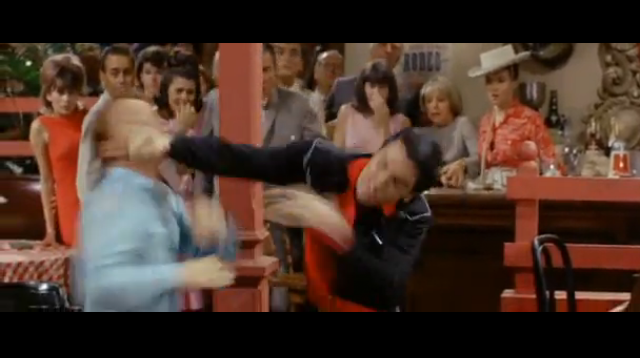
Not only is their society unprogressive, they are underdeveloped mentally as well.  Johnny Tyronne is kidnapped by assassins because of his prowess in film.  In his movie he karate chops a leopard in the neck, so he must be a valiant real-life warrior. Such logic is also what allows Johnny to fool an Arab in a fight by saying "hey, look over here" before punching him like one of the Three Stooges.  The "otherness" of the Arab people is accentuated in that the film takes place in the fictional nation of Lunarkand.

Perhaps it is unfair, but I have an easier time forgiving films that make stereotypical use of foreign cultures the further you go back in film history.  In my mind, Sex and the City 2 is worse than Carry On Up The Khyber is worse than Gunga Din is worse than The Son of the Sheik is worse than Birth of a Nation, and that's a moralistic statement as well as an artistic one.  As insulting as these films are on a human level, there is an increased indictment of "should have known better" the further you crawl along film's short timeline.  If D.W. Griffith was already trying to atone by 1916's Intolerance, it is difficult for me to imagine a group of film executives giving the green light to Harum Scarum in 1965 amid the ideological shift of the civil rights movement.

The cheap production values make it seem lost in time.  The film was shot in the studio, reusing sets from Cecil B. DeMille's 1925 film The King of Kings and borrowed costumes from 1944's Kismet.  Physically, Elvis looks worse than he did in Roustabout and the lighting and makeup don't help.  The film was helmed by producer Sam Katzman and director Gene Nelson, the same quickie team that relied on stereotype and elitism for laughs in the nearly-as-atrocious Kissin' Cousins.  Elvis was excited to play an updated Rudolph Valentino, so much so that Priscilla recalls him coming home in full costume and makeup to get into the role. 

It's amazing to me how many times Presley hoped that something more would come of his pictures, never fully realizing that he was had.  Harum Scarum marks one of the only times that both Presley and Colonel Tom Parker saw eye to eye regarding the insipid nature of the screenplay.  Presley did return to the studio to record and uninspired soundtrack, but the creative genius that was Colonel Parker (who must have still been laughing at the singing horse in Tickle Me) went so far as to suggest that the screenplay could benefit with the addition of a talking camel.

Harum Scarum insults the core of what it is to be human.  On the surface, it's moronic, lightweight and full of bad songs.  Cutting deeper, the film is racist, elitist, condescending, misanthropic and hateful.  Worse, it was a success in 1965.  The nadir of Presley's film career would bottom out just schist layers from this one in Stay Away, Joe.  It is a film guilty of the same bad taste executed with the same shit-eating grins.  You know, I take it back:  Stay Away, Joe at least employed Native Americans rather than greasing up English-speaking white guys named Joey Russo, Billy Barty and Phillip Reed playing characters named Yussef, Baba and Toranshah. -- ZERO/four stars


Back to The Films of Elvis Presley

Click Here, Nimrods...

Friday, April 22, 2011

Tickle Me (1965, Norman Taurog)

Tickle Me is an exercise in how I have no qualms, whatsoever, with eye-roll inducing, ludicrous plots as long as the film is comfortable in its own skin.  In what boils down to an episode of "Scooby Doo" taking place at a fat camp, Tickle Me is a more immature The Ghost and Mr. Chicken with an entirely forgettable soundtrack.  Even the title is nonsensical.
 
After putting his foot down in a string of disillusioning studio sessions during the filming of Girl Happy, Elvis refused to record.  Tickle Me features no new recorded music and probably suffered for it.  The soundtrack is a hodgepodge of earlier, non-film recordings (some from as far back as 1961), and didn't have a conventional LP release.  As such, the songs in the movie are odd.  The lip-syncing efforts are not the greatest, and although a number of the songs aren't bad per se, they have little narrative purpose.  Ironically, "Such An Easy Question" and "I'm Yours" both charted higher than anything Elvis did since before Kissin' Cousins (including "Viva Las Vegas"), and better than any movie single for the remainder of his career.

Elvis's Lonnie Beale shows up in Western Podunk only to find out that his would-be employer skipped town.  In a moment of rare self-reference, Lonnie acknowledges that he needs to find a way to eat before the possibility of earning money at an upcoming rodeo.  "Don't tell me.  I know,"  Lonnie tells the local bartender before a smash cut close up of him performing with a guitar.  Speaking of self-reference, Lonnie soon gets in an extended fist-fight with a drunk patron which would have us rolling our eyes, only it is a saloon. 

Tickle Me is not afraid to take jabs at itself, and works because of its sense of humor.  Its success comes in how wildly the film goes off the deep-end compared to the accustomed formula.  Take the premise:  Former rodeo-rider Lonnie arrives in a new town, moonlights as a nightclub singer, works the day at a ranch.  Here, women fall over each other, biding for his attention and we expect a rehash of one of two typical Elvis plotlines.

1) Rebel Elvis works his way out of these hard knocks, stands up for a woman who he wins over before also winning the big rodeo.

2) Romeo Elvis fraternizes with a number of the women, behind each others' backs in sticky situations before (as Westerns so often teach us), he becomes a man of his own needing only his horse and riding off into the sunset.

Instead, the film takes a left turn and we get a third, unpredictable scenario.

3) Elvis takes a shine to a single woman at the ranch who enlists him into snooping around a local ghost town for clues to her deceased grandfather's hidden gold.  The team are frightened by locals after the same treasure, and they would have gotten away with it too, if it weren't for the meddling kids.  Elvis celebrates by getting married, forgetting about the rodeo and fighting a ninja.

There are shades of Jerry Lewis in Lonnie's sidekick Stanley (Jack Mullaney), and Elvis is given slapstick that is entirely new to his range.  I'm not overstating the "Scooby Doo" stuff-- "ghosts" show up, only to disappear when Stanley makes Lonnie double-check them, the perpetrators are characters we knew all along, and it concludes with a grand unmasking.  Multiple characters fall out of a fake door into a mud pit and a horse even sings part of a song.  Seriously, have I not sold this thing already?  -- ***/four stars


Back to The Films of Elvis Presley
Click Here, Nimrods...

Thursday, April 21, 2011

Girl Happy (1965, Boris Sagal)

Girl Happy is the movie Girls! Girls! Girls! should have been: a pleasant spring break romp light on consequence, but playful rather than insulting.  Girl Happy is a thematic combination of Some Like It Hot and Chasing Liberty.  As the former is a four-star movie and one of the best films of all time, and the latter is a zero-star movie and (no hyperbole) one of the worst of all time, it seems appropriate that Girl Happy placidly plateaus out as a two-star affair.

Elvis plays Rusty Wells who, along with his band of indistinguishable doofuses, is starting to make it big in the nightclub scene in the chilly Chicago spring.  Desperate to escape the cold, they pack their bags, ready for their annual trip to Fort Lauderdale for spring break; the only problem is, the boss wants to sign them for an extension.  Lucky for them, he has a college-aged daughter who wants to go to Florida rather than come home for Easter weekend and Rusty and the boys are sent down to keep an eye on her.  You know full well they fall in love and, like G.I. Blues, the girl is going to be none too pleased when she hears the backstory.  Chances are, they'll probably work it out.

The screwball antics (like the early '60s Presley persona) are pandering but pleasant.  There are a few moments of true chaos that do the genre justice (highlights include a Long, Long Trailer-style sequence that ends with a boat docking in a swimming pool and Rusty having to entertain two dates at the same time without letting on about the other).  More significant is Presley's ability to play the comedy rather straight despite his personal conflict with the material.  This film, as well as his next, Tickle Me, showcase Presley as comedic actor rather than phenomenon, and they are better for it.

Though billed as a beach movie, the low budget has most of the film take place at a pool outside a motel.  The film is not shot on location and, as such, the shadows look weird a lot of the time.  And although there are plenty of bikinis, Elvis is often wearing long-sleeves.  I feel like the female audience was a little disenfranchised as Girl Happy again waxes (slightly) misanthropic despite its female target audience.  It certainly isn't as insulting or mean-spirited as Girls! Girls! Girls!, but the eye-candy gets wearisome and isn't consummated.

While Hal Wallis didn't back out of the Elvis franchise until after Easy Come, Easy Go, in many ways Girl Happy was the beginning of the end for the Elvis musical-comedy.  It was the last film in Elvis's career to produce monumental returns and, while every Presley film was profitable, box office returns and soundtrack sales rapidly declined after Girl Happy.  It's difficult to say whether audiences grew tired of the formula, or it was a product of changing times, but the formula didn't adapt.  Strangely, as Girl Happy came at the height of Beatlemania in America, the film's quick fix to reach the youth demographic was to slightly speed up the songs.  None of the six singles Presley released in 1964 cracked the top ten, and the changes are something of a fundamental misunderstanding by the fogeys in charge of what was driving youth culture.  The film's single, "Do The Clam", only reached 21 on Billboard's Pop chart despite the Chipmunk treatment.  Masking the symptoms doesn't cure the disease, and even Elvis knew what that was.  Frustrated with the sub-par material in the recording sessions, Elvis walked out of the studio after 36 takes of "Do Not Disturb" and didn't record again for eight months. 

The narrative also bears last ditch efforts at marketability.  The kids loved George Harrison shaving in A Hard Day's Night, so now Elvis is teamed with a full group of lunks who fight with shaving cream in the dressing room.  There is something to be said for the success of "The Monkees", but Girl Happy fails to even make its minor characters distinguishable, let alone fleshed out.  The strongest characters in Girl Happy are its women.  Shelley Fabares is striking and spunky, and her innocence runs diametric to Mary Ann Mobley's knowing sultriness.

Ultimately, Girl Happy is a mild success because the situational comedy is punched up.  The film doesn't follow the typical travelogue formula and, while nothing is fully developed, there is enough groundwork to make the lark enjoyable.  The dominoes were lined up for the end of Presley's film career (even the idea of Elvis living in a state of arrested development as a 30-year old still going to spring break is a stretch), and the more successful Elvis pictures from here allow him to be an adult.  Much to the Colonel's approval, old hat worked one more time here. -- **/four stars


Back to The Films of Elvis Presley

Click Here, Nimrods...

Tuesday, March 8, 2011

Ship of Fools (1965, Stanley Kramer)

Ship of FoolsMy problem with Stanley Kramer's Ship of Fools is twofold: the source material and the adaptation.  Based on Katherine Anne Porter's best-selling (and only) novel, Jewish screenwriter Abby Mann was given the unfortunate assignment analogous to writing an animated short of Anna Karenina.  Only, in the hands of Kramer, the piece must also both heavy-handedly condemn the Nazi party (not a problem as Porter's text hates not only Nazis, but equates the German bloodline with it) but create a sympathetic (if naïve) Jewish character to deliver the message with very broad stokes (very much a problem as Porter's text is often, strangely enough, anti-Semitic and never given bullet-points).

Porter's novel is best as a series of vignettes that allows different faces of humanity to react to larger issues.  Hollywood narrative disallows any such storytelling and instead tries to introduce just as many characters (the ensemble cast pictures 27 in the opening credits) in a medium with a sweeping arc.  Passengers board a German ocean liner headed to Europe from Vera Cruz, Mexico in 1933.  Even the film's tagline presents the characters as stereotype ("Explorer, mistress, vagrant, loafer, artist, tramp...") and it is easier (though unfair) to talk of them in only this way.  The passengers dine, flirt, regret and wax philosophic in a way true to a one-dimensional theme (frivolity) if unfair to much of the tone.  Springboards for insight into the characters are often fumbled in the picture as minor happenstance.  A keystone in the novel involving a minority dying while jumping overboard to rescue a pampered, German bulldog is present here, but only for a lone bastion of humanity to give a grand, Elephant Man nudge to the audience that he was a human being.  The novel's personification of philosophies is traded for soap opera.

Ship of Fools is a tale of disease rotting from the core.  The film has the disease metaphorized on the historic horizon.  Compare Kramer's Ship of Fools to Luchino Visconti's take on Thomas Mann's Death In Venice a mere six years later to expose how highfalutin, broad and misappropriated the former is to a similar tone.  Whereas Death In Venice bathes us in sickly yellows, Ship of Fools gives us an inordinate amount of ill characters who we largely don't remember as ill.  Strangely, Ship of Fools won the Academy Award for best cinematography for a job that mainly skirts the issue--as if a novel of sometimes schizophrenic double-consciousness can be fairly summed up as "black and white."

At its worst, Ship of Fools feels weighty for the sake of weightiness.  The passengers disembark upon arrival in Germany, but the intended cynicism in which our diseased characters search for utopia in a land beginning to reap the hatred that would lead to World War II is lessened as it feels like a period piece-- as if the modern audience has grown beyond it.  This is still a film in which 600 Mexican deportees are one-dimensionally violent and, though the film tries to convince itself they are equals, lest we forget Porter's own source material often equates poverty with racial, genetic inferiority.  Conversely, where Porter's Holocaust terrorized invalids alongside Jews, elderly alongside minority, Kramer's Holocaust is very much a Jewish Holocaust (strange as the lone Jew is still very minor and very doe-eyed).  Worse, it vilifies Germany in a way that edifies America-- a sentiment counter-intuitive to the text.  Kramer and Mann dole blame with much too broad strokes in a way that was much more successful in their Judgment at Nuremberg.  This film wants to feel as important, but often chokes us, guilty of the same weighty frivolity of its characters. -- *½ / four stars

Click Here, Nimrods...